

not everything feels like something else.
detachment, romanticism, and our fear of life in its rawest form.

I came across this excerpt of a short story from Pinterest and absolutely fell in love with it:

“I ask Jessica what drowning feels like, and she says not everything feels like something else.”
A simple statement, yet so profound. The sentence took so many forms for me. A protest, a realisation, a confrontation. The refusal to let a horror exist as anything other than it was. Stumbling upon this on my Pinterest felt like plunging into ice-cold water. It shuddered through my bones and shook the dark corner of myself, disturbing a hunched, bony sculptor working away in the background: the part of my mind that took pain and moulded it into symbols and words.
From this part of myself, I produce beautiful things. But this sculptor likes to hold the rest of myself hostage, too focused on the art, on calling the pain something else, rather than letting it leave.
To suffer is an inventible part of the human experience. Pain gives joy a plinth to stand upon and in turn helps us understand the value of good within the world. But despite pain’s role as a part of a permanent process, we all like to make sense of our suffering.
The most popular way is the age old question: “What does it feel like?”
We seek sense in suffering through finding it’s counterpart somewhere else. To compare to something that we can understand as an concept as rather
“Heartbreak feels like…”
“My grief feels like…”
But as Jessica says in the excerpt above, drowning doesn’t feel like something else. It feel’s like drowning. Trying to articulate it in any other way wouldn’t do it justice. And I believe this spoke to a deep-rooted societal habit that is equally comforting as it is destructive.
We create metaphors and symbolic meaning out of suffering, because we seek a form of justification for pain, a way to find a positive out of it. Creating something, whether that’s art, a self-rebrand, or anything significant out of despair gives it a purpose, makes it worth it.
(For the purpose of this essay, I am going to focus on the artistic side of this topic.)
We artistically profit off intense emotion because it offers us an infinite well of inspiration to draw upon. I am always in a constant battle with inspiration, and there are days where I catch myself mourning a dark period of my life because of the magnitude at which I would create during it. There was so much to work with. So much potent emotion that I made beautiful, profound things from.
But did writing help me heal from it? Or did I surrender myself a mouthpiece for my sadness?
Last year was hard. Very hard. However, I decided not to write about it immediately. I sat with it, talked about it, worked through it. And I must say, I came out the other side faster and with a clearer perspective. I didn’t let myself wallow in that state. Now, I can draw on that experience to write, yet simultaneously not be enslaved by it.
As much as I believe and practice creating art from pain as cathartic coping mechanism, when it is abused, it can severely detach us for being able to confront an issue in its entirety. To immediately rush to the rose-tinted glasses, to try make suffering beautiful and poignant by attaching it to an aesthetic or give it artistic meaning, we actually end up avoiding letting it go. Stuck in a permanent state of autopsy, rather than moving on to burying the body.
As the famous quote from the Netflix series BoJack Horseman goes: “That means that all the damage I got isn’t ‘good damage’. It’s just damage. I have gotten nothing out of it and all those years I was miserable was for nothing”.
Our need for pain to be worth it becomes expectation. We suddenly expect our suffering to be important, because we feel it so greatly that is must mean something. A divine intervention, a sign, a turning point in your life.
But there are so many times where we’ve suffered greatly in such heinous and unfair ways, and stumbled out the other side with no poems, no songs and no stories. Just a fresh set of scars and another knife in your side to pull out and heal from.
And that, as much as it seems cruel and aimless, is okay.
You are allowed to not make something out of your suffering. Sometimes there isn’t a ‘feels like’. Sometimes pain isn’t profound.
Pain is allowed to exist as it is. Grief can be grief, heartbreak can be heartbreak. And you are not weaker, or less important than someone who turned their suffering into something ‘good’ or ‘worth it’. Desperately trying to find symbolic meaning in pain that feels pointless betrays the human part of yourself that is just simply feeling it.
Sometimes, it’s kinder to yourself to refer to a feeling by it’s real name.
I’ve realised that by immediately writing about my pain as it is fresh of the press retains it like a bug in amber. In my attempt to create sense of of my emotions, I end up giving it an identity other than it’s own. I create an entity, rather than labelling it as a period of time that I can shed with it’s passing.
It is that kind of artistic process that creates the tragic greats like Sylvia Plath. She created masterpieces out of her despair, and in the process may have staked a fire that once warmed her into a wildfire out of her control.
And when we rely on potent, all-consuming negative emotion to create, then we start to seek it out. It is then when you cross the line from following a creative urge to self-sabotage.
With the emotional & cognitive onslaught dealt by social media and the torrent of horrors within current affairs, we have been shaped, Gen-Z specifically, to become rather fragile and reliant on distraction. Romanticism is perpetuated through the constant visual associations with suffering. Aesthetics are the centrepiece of social media, and when you are consistently consuming media that attaches negative emotion with a certain image, we want to assimilate that image into our pain. To romanticise it.
But romanticism is like putting on a show for an empty theatre. No one is watching you, so why are you still performing? Why do we feel the need to create a spectacle out of our sadness for no one other than ourselves? To detach and numb, sedating ourselves by saturating our suffering till it’s as vibrant as joy. Why do we blur the line?
To conclude, I do believe we must always seek meaning within life. I am no nihilist, and I believe everything does have a purpose- just maybe we don’t have to create one ourselves.
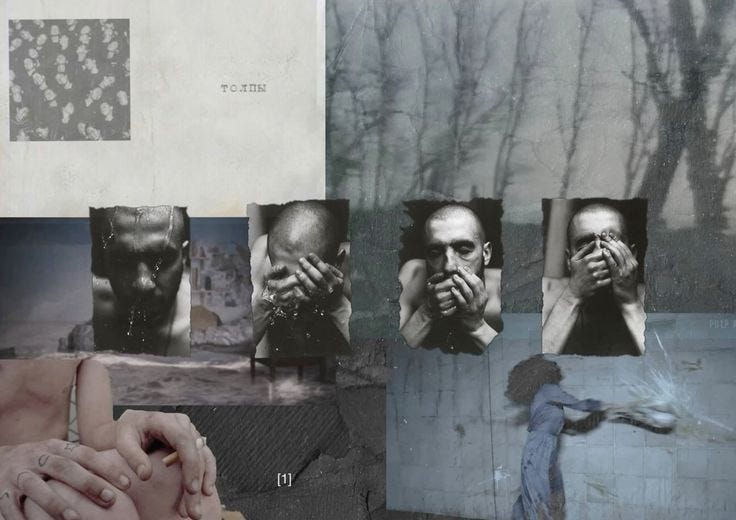
Art is a reaction. Emotion will always play a role within the artistic process. But it’s important to make sure your well of inspiration draws on a variety of things that aren’t directly attached to you. The key is to just simply step back sometimes, let yourself feeling a sensation at it’s rawest before putting the pen to paper. Articulate to a friend, a loved on, someone who will listen without judgement, and relearn the art of simply being.
Contrary to what you may believe, that is the whole point.
“to try make suffering beautiful and poignant by attaching it to an aesthetic or give it artistic meaning, we actually end up avoiding letting it go” so relatable…
Your writing is really beautiful🫶🏻
I appreciate you adding in the element of pain being needed or feeling like it has to mean something. Enjoyed this piece so
much.